MAGIC

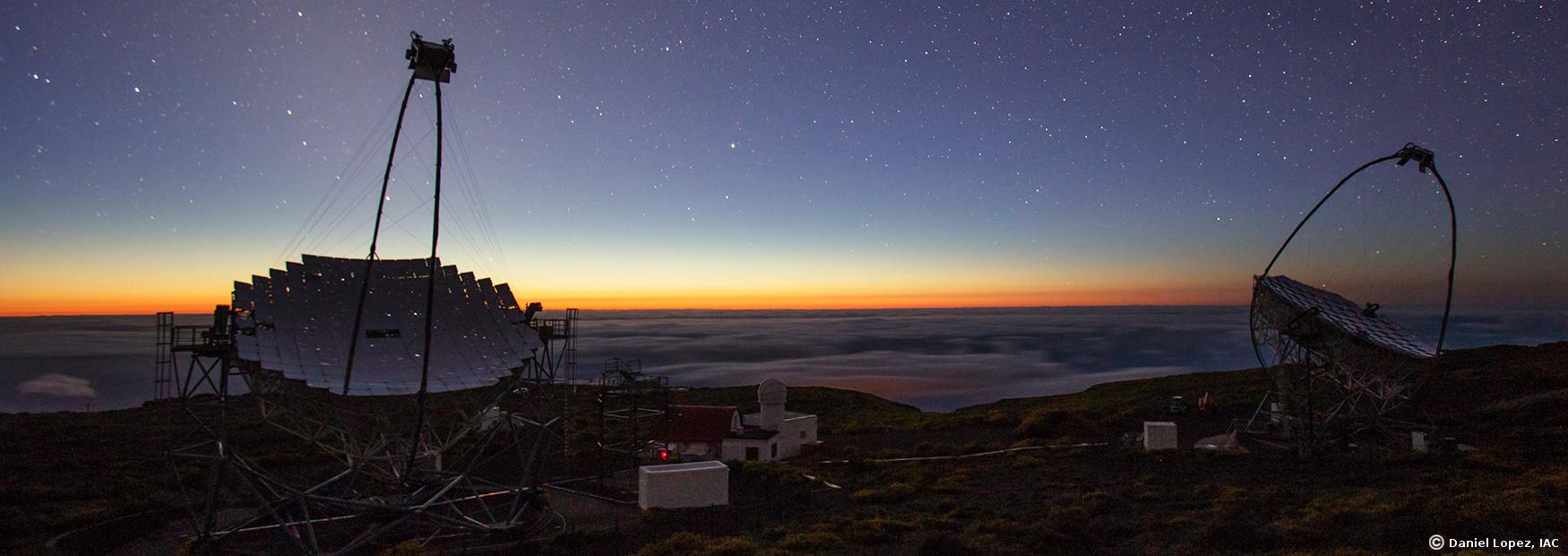
MAGIC Site picture
Home
Latest news
MAGIC
The Collaboration
Meetings and
Conferences
Physics
Publications
Internal Documents
Working Groups
Operations
Gallery
Webcams
Links
 

Deutsche Version


Welcome to the homepage of the MAGIC Telescopes!

Gamma-ray astronomy at low energies with high sensitivity

The MAGIC Collaboration has built in 2001–2003 a first large atmospheric imaging Cherenkov telescope, MAGIC-I, with a mirror surface of 236 sq.m. and equipped with photomultiplier tubes of optimal efficiency. In 2009, a second telescope of essentially the same characteristics was added; MAGIC-II was installed at a distance of 85m from MAGIC-I. With the accent of these instruments on large mirror surface and best light collection, cosmic gamma-rays at an energy threshold lower than any existing or planned terrestrial gamma-ray telescope have become accessible. So far achieved has been a threshold of 25 GeV.

Latest news

    MAGIC discovers VHE gamma-ray emission from the flat spectrum radio quasar PKS1222+21 Very High Energy (VHE) gamma-ray emission from the flat spectrum radio quasar (FSRQ) PKS 1222+21 (4C 21.35, z=0.432) was detected with the MAGIC Cherenkov telescopes during a short observation (~0.5 hr) performed on 2010 June 17. The MAGIC detection coincides with high energy MeV/GeV gamma-ray activity measured by the Large Area Telescope (LAT) on board the Fermi satellite. The VHE spectrum measured by MAGIC extends from about 70 GeV up to at least 400 GeV and can be well described by a power law with a photon index Gamma= 3.75+/-0.27stat +/-0.2syst. The averaged integral flux above 100 GeV is (4.56+/-0.46)x10^(-10) cm^-2 s^-1 (~1 Crab Nebula flux). The VHE flux measured by MAGIC varies significantly within the 30 min exposure implying a flux doubling time of about 10 min. The VHE and MeV/GeV spectra, corrected for the absorption by the extragalactic background light (EBL), can be described by a single power law with photon index 2.72+/-0.34 between 3 GeV and 400 GeV, and is consistent with emission belonging to a single component in the jet. The absence of a spectral cutoff constrains the gamma-ray emission region outside the Broad Line Region, which would otherwise absorb the VHE gamma-rays. Together with the detected fast variability, this challenges present emission models from jets in FSRQ-s. Moreover, the combined Fermi/LAT and MAGIC spectral data yield constraints on the density of the Extragalactic Background Light in the UV-optical to near-infrared range that are compatible with recent models. Get the full article here

    MAGIC reobserves the flat spectrum radio quasar 3C279 The most distant known VHE gamma-ray emitter, quasar 3C279 (z=0.536), was observed with the MAGIC-I telescope in 2007 and 2009. The January 2007 observations were triggered by a major optical outburst in the source (reported by the Tuorla blazar monitoring program) and resulted in detection on January 16 with high significance, the overall data sample not showing a significant signal. The December 2008-April 2009 observations also did not detect the source. The detection in 2007 challenges standard one-zone model, based on relativistic electrons in a jet scattering broad line region photons. Read more in the published article

    MAGIC detects a new BL Lac-object, ON325, in VHE gamma-rays The MAGIC Collaboration reports the discovery of Very High Energy (VHE; >100 GeV) gamma-ray emission from the BL Lac object 1ES 1215+303 (also known as ON325) with z=0.130 (White et al. 2000 give z=0.237). The MAGIC observations, triggered by an optical high state of the source reported by the Tuorla blazar monitoring program, detected the source in a 5.6 hour-long observation performed from 2011 January 2nd to 5th. The preliminary analysis of the MAGIC data using standard cuts yields a detection of 25 gamma-rays above 250 GeV, corresponding to a statistical significance of 5 standard deviations. The observed flux is estimated to be (2.0+/-1.0)% of the Crab nebula flux above 250 GeV. Issued as Astronomical Telegram #3100 on 6 January 2011

    MAGIC detects very high energy gamma-rays from IC 310, a head-tail radio galaxy in the Perseus galaxy cluster This source was observed between November 2008 and February 2010. The Fermi satellite has also detected this galaxy. The source is detected by MAGIC at a high statistical significance in 20.6 hr of stereo data. The observed spectral energy distribution is flat with a differential spectral index of -2.0. The mean flux above 300 GeV, between October 2009 and February 2010, corresponds to 2.5% of Crab Nebula units. Only an upper limit, of 1.9% of Crab Nebula units above 300 GeV, had been obtained with the 2008 data. This, together with strong hints (>3sigma) of flares in the middle of October and November 2009, implies that the emission is variable. The MAGIC results favour a scenario with the very high energy emission originating from the inner jet close to the central engine. Read more in the article published as an ApJ Letter.

    MAGIC reports new observations of the intermediate-frequency peaked BL Lacertae object 3C 66A with the MAGIC telescopes in stereo mode. The data sample was taken in late 2009 and early 2010. In this period, we find a significant signal from the direction of the blazar 3C 66A. The new MAGIC stereoscopic system is shown to play an essential role for the separation between 3C 66A and the nearby radio galaxy 3C 66B, the sources being at a distance of only 6 arcminutes. Read more in the submitted article

    MAGIC reports upper limits for sources in the region around supernova remnant G65.1+0.6 . This region hosts the two bright GeV gamma-ray sources 1FGL J1954.3+2836 and 1FGL J1958.6+2845. They are identified as GeV pulsars and both have a possible counterpart detected at about 35 TeV by the Milagro observatory. MAGIC found no significant emission around 1 TeV, from 25.5 hours of good quality data. This implies that the Milagro emission is either extended over a much larger area than our point spread function, or it must be peaked at energies beyond 1 TeV. Read more in the submitted article, to be published soon in ApJ.

    MAGIC reports upper limits for Cygnus X-3. Cygnus X-3 is a microquasar consisting of an accreting compact object orbiting around a Wolf-Rayet star. It has been detected at radio frequencies and up to high-energy gamma rays (above 100 MeV). However, many models also predict a very high energy (VHE) emission (above hundreds of GeV) when the source displays relativistic persistent jets or transient ejections. Detecting such emission would improve the understanding of the jet physics. In observations of Cygnus X-3 over about 70 hours between early 2006 and mid-2009 in different X-ray/radio spectral states and also during a period of enhanced gamma-ray emission, MAGIC found no evidence for a VHE signal from the direction of the microquasar. Read more in the article, published in ApJ.

    MAGIC discovers VHE gamma-ray emission from the high-frequency peaked BL Lac object B3 2247+381 MAGIC observations, triggered by an optical high-state of the source, reported by the Tuorla blazar monitoring program, revealed gamma-ray emission from the blazar B3 2247+381. This AGN, located at an intermediate distance of z=0.12 for its kind, was detected in E> 150 GeV gamma rays after a 9.3 hour-long observation performed on 2010 September 30th, October 1st, 2nd, 4th, 5th and 6th with both MAGIC telescopes working in stereoscopic mode. The preliminary analysis of the MAGIC data using standard cuts yields a detection of 64 gamma-rays, corresponding to a pre-trial statistical significance of 5 standard deviations. The observed flux is estimated to be ~2% of the Crab nebula flux above 150 GeV. MAGIC will continue to observe B3 2247+381 and encourages observations at other wavelengths. Issued as Astronomical Telegram #2910 on 7 October 2010.

    MAGIC detects a huge VHE flare from the flat spectrum radio quasar 4C +21.35 In a recent Astronomer's Telegram, the MAGIC collaboration reports the detection of a gamma-ray outburst from the Flat Spectrum Radio Quasar 4C +21.35, located at a redshift of z=0.432. The observation was performed in stereoscopic mode during low intensity moon light using the two 17m diameter imaging Cherenkov telescopes on La Palma, Canary Islands, Spain. During only 0.5 hours on June 17, 2010, preliminary results indicate a significant gamma-ray signal of 120 excess events corresponding to >8 sigma level above the background. The integral flux for gamma-rays with energies above 100 GeV is estimated to be at >30% of the Crab nebula flux. MAGIC will continue to observe 4C +21.35. Issued as Astronomical Telegram #2684 on 19 June 2010.

    MAGIC and VERITAS detect dramatic flaring of the giant radio galaxy M87 at an unprecedented flux level M87 is being observed in a coordinated effort in 2010 by the ground-based VHE gamma-ray observatories VERITAS and MAGIC; this effort is a continuation of the joint monitoring program which was initiated by VERITAS, MAGIC, and HESS in 2008. An increasing VHE gamma-ray flux level has been measured over several nights starting on 2010-04-05, reaching a historic high state of about 20% of the flux of the Crab Nebula during the observations on 2010-04-09. This flare follows a state of low average VHE flux from M87 over the past few months after a flare was reported by MAGIC earlier in 2010. Issued as Astronomical Telegram #2542 on 9 April 2010.

MAGIC status

Located on a mountain top on the Canary island of La Palma, the construction of this world-wide largest telescope (MAGIC-I) has been completed in 2003. Fully operational since 2004, it is run by an international collaboration of 17 institutes (see MAGIC Collaboration). A second telescope, MAGIC-II, on the same site, has been completed and is presently (mid-2009) in the commissioning phase. In large parts, it is a copy of MAGIC-I, but has a more homogeneous camera with more pixels, and a refurbished readout.

The first light ceremony of the MAGIC-II telescope took place on 2009 April 24-25. MAGIC-II is located at a distance of 85 m from the first MAGIC telescope, which has been in operation since 2004. It is expected that the stereo operation of both telescopes will increase the sensitivity of the observatory by ~3 times. For this occasion, a half-day scientific seminar on the MAGIC Project was organized in La Palma on 24 April 2009. The First Light ceremony at the MAGIC site took place in the morning of 25 April 2009. Some of the echos in the press and the material prepared for journalists can be found here.

Job Opportunities

MAGIC aspects

Experience an interactive panoramic tour of MAGIC (March 2008: the MAGIC-II telescope is under construction),

or listen to the cosmic voice of MAGIC,

or inspect a small collection of early raw data: images from early MAGIC events (2003 / 2004).

More Information on MAGIC:


The MAGIC Telescope Project is primarily supported by the following funding agencies:


BMBF = Bundesministerium für Bildung und Forschung (Germany)
MPG = Max-Planck-Gesellschaft (Germany)
INFN = Istituto Nazionale di Fisica Nucleare (Italy)
MCI = Ministerio de Ciencia e Innovacion (Spain)
SNF = Swiss National Science Foundation (Switzerland)


This page was created by Robert Wagner. Last modification 08.05.2011 by Robert Wagner.
The MAGIC Telescope web pages are hosted at MPI für Physik, Munich. Imprint